
The tripartite model of attention
A central theme in recent work is the tripartite model of attention. This model describes attentional control as the outcome of three interacting forces: top-down goals, bottom-up salience, and selection history. Attention is not controlled by one single mechanism, but emerges from the competition between what we are trying to do, what is physically salient in the environment, and what we have learned from previous experience (see Annual Review of Psychology 2025)
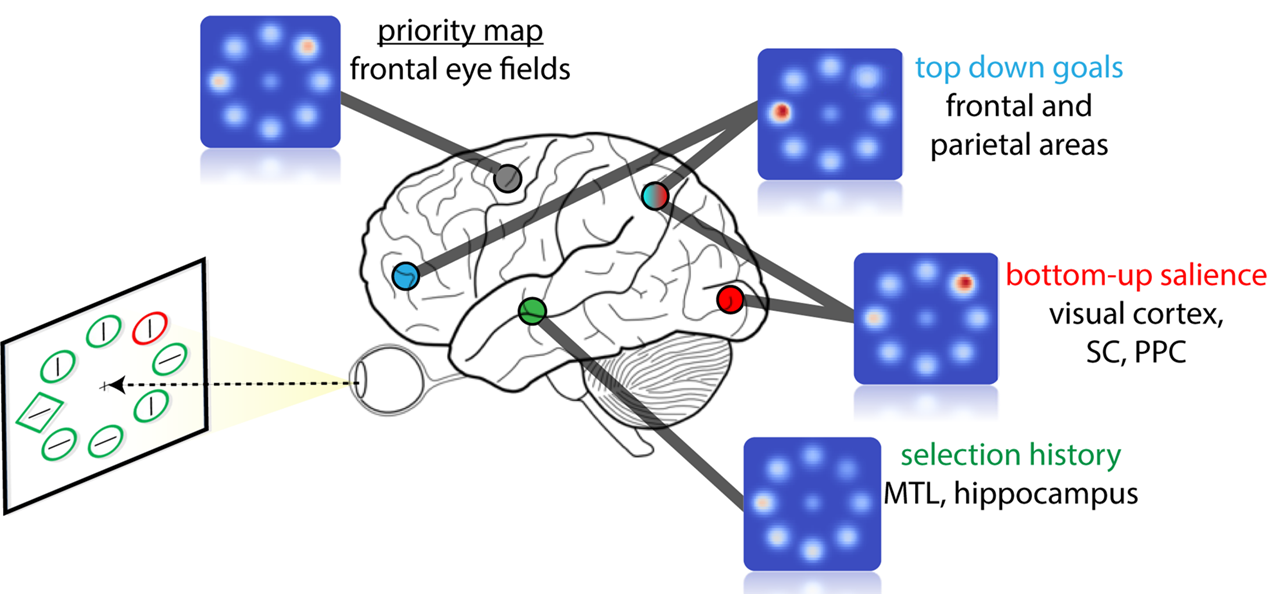
Tripartite model of attentional control (Theeuwes, 2025) involving top-down (goals), bottom-up (saliency), and history driven (statistical learning) control with the assumed brain areas involved.
Top-down and bottom-up control of attention
Much of the research has contributed to the long-standing debate about top-down versus bottom-up control of attention: are we in charge of what we select, or is the environment in charge? The work has shown that salient objects can capture attention automatically, even when they are irrelevant to the task. At the same time, more recent studies show that selection history and statistical learning strongly shape what is selected or suppressed. This has helped move the field beyond a simple distinction between top-down and bottom-up control.
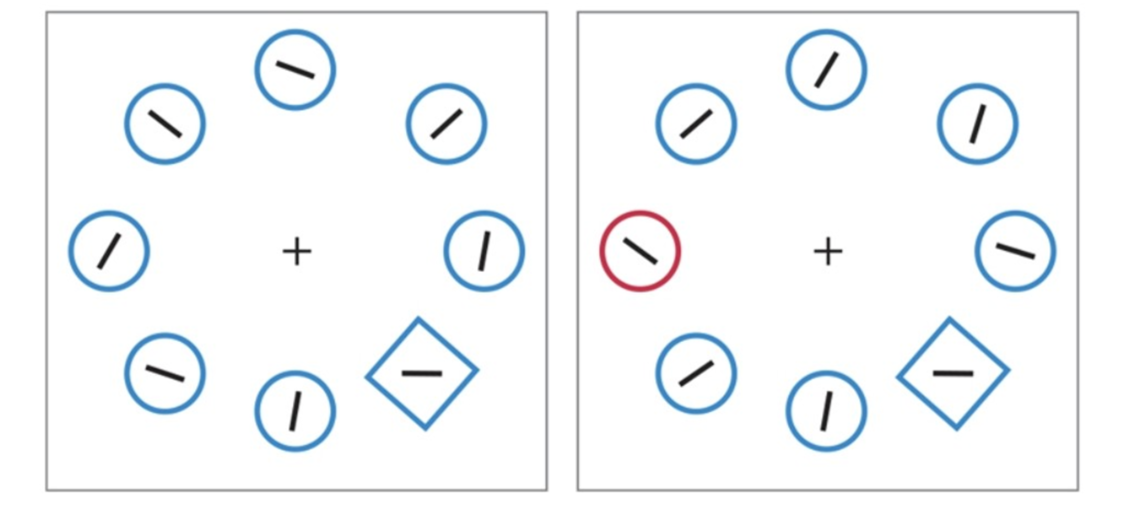
The additional singleton paradigm developed by Theeuwes (1991, 1992). Participants search for a diamond among circles. When an irrelevant color singleton is present, such as the red circle, responses are slower. This finding provides evidence that salient distractors can capture attention automatically, even when they are irrelevant to the task.
Eye movements
A major line of research concerns eye movements and the question of where people look in complex visual scenes. The competitive integration model explains saccade selection as the result of competition and integration between visual salience, task goals, and oculomotor biases. This work shows how attention guides the eyes, and how the eyes in turn reveal which objects or locations are selected for further processing.
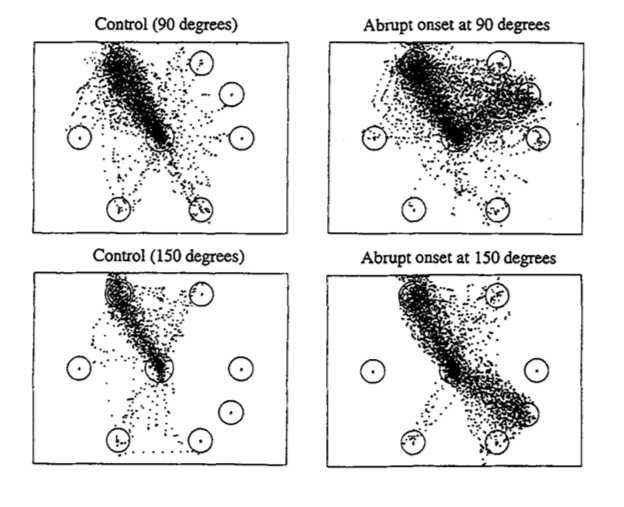
Eye-movement behaviour in the oculomotor capture paradigm. When an abrupt onset is presented 90° or 150° away from the target location, the eyes tend to move toward the onset, as shown on the right. This pattern is absent in the control condition, shown on the left. Adapted from Theeuwes et al. (1998, JEP: HPP)
Applied traffic research.
This example shows the recording of eye movements during driving. Jan Theeuwes’s company conducts applied research on traffic safety, with a particular focus on how road design, signage, and visual information influence driver behaviour. More information on this work, including examples of research conducted for the Dutch Department of Transport and various companies, can be found on the TheeuwesAdvies website.